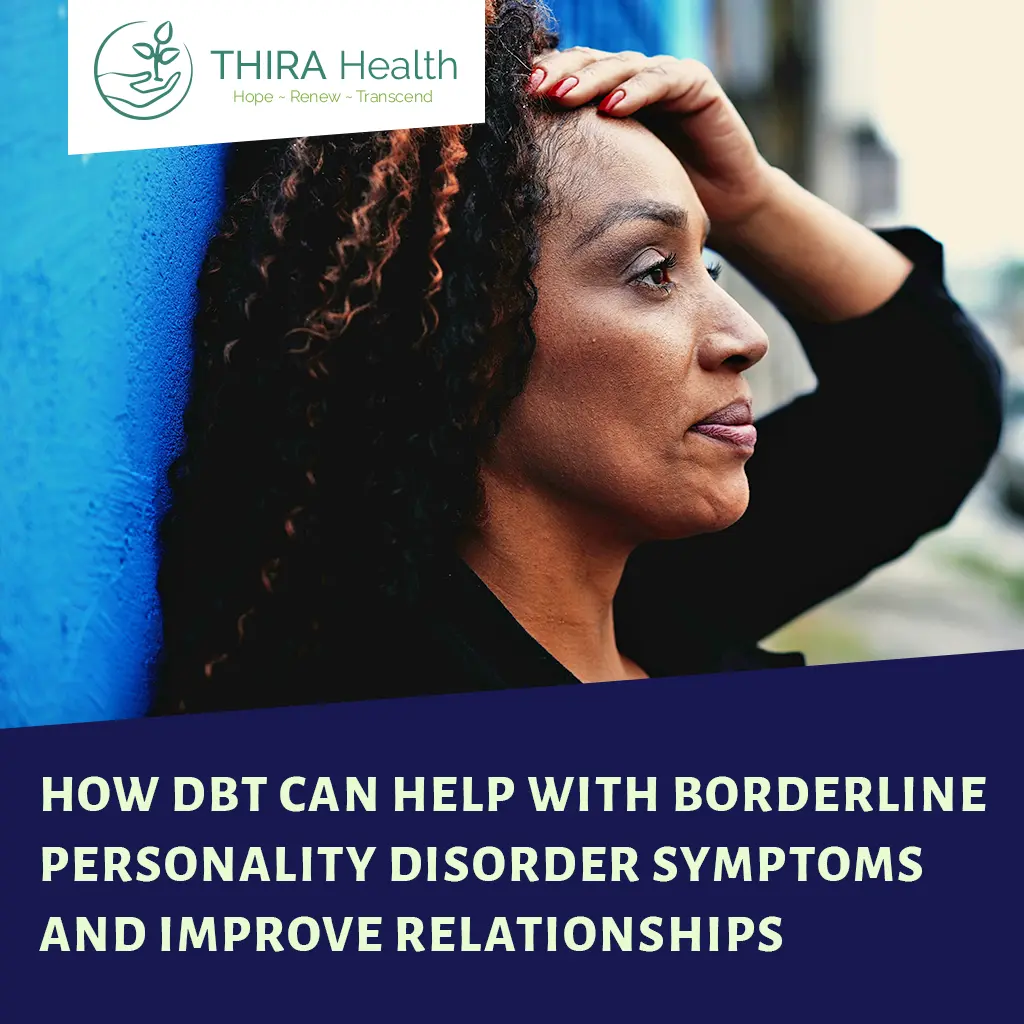
Living with borderline personality disorder symptoms can feel overwhelming, especially when emotions shift quickly, relationships feel intense, or small moments seem to turn into painful spirals.
For loved ones, BPD can also be hard to understand. People may see the reactions but miss the fear, pain, sensitivity, and effort underneath them.
Dialectical Behavior Therapy, or DBT, was designed to help people build practical skills for moments like these. DBT does not ask someone to simply “calm down” or “try harder.” It teaches specific skills that can be practiced over time with support.
For many people, that difference matters.
DBT helps people notice what is happening inside them, tolerate painful moments without making things worse, communicate more clearly, and build a life that feels more stable and connected.
This article explains how DBT can help with borderline personality disorder symptoms, emotional regulation, distress tolerance, relationships, and daily life.
THIRA Health provides DBT-centered mental health treatment near Seattle and Bellevue, Washington, with connected levels of care that may include residential treatment, a Partial Hospitalization Program, and an Intensive Outpatient Program depending on clinical fit.
What Is Borderline Personality Disorder?
Borderline personality disorder is a mental health condition often associated with intense emotions, relationship stress, fear of abandonment, impulsive reactions, and difficulty feeling steady.
People experiencing BPD symptoms may feel emotions more intensely and for longer periods of time. A situation that may seem small from the outside can feel urgent, frightening, or deeply painful from the inside.
BPD symptoms can affect:
- Mood and emotional stability
- Relationships
- Self-image
- Decision-making
- Coping behaviors
- Sense of safety and connection
- Trust and communication
It is important to say this clearly: people with BPD symptoms are not “too much,” “manipulative,” or “attention-seeking”.
Many are trying to manage emotional pain that feels overwhelming, fast-moving, and hard to explain. They may want closeness but fear abandonment. They may want stability but feel pulled into reactions they later regret.
The right support can help.
With treatment, structure, and repeated skills practice, many people can learn new ways to understand their emotions, respond to distress, and build healthier relationships.
What Is DBT?
Dialectical Behavior Therapy is a structured, skills-based therapy that helps people build tools for managing emotions, tolerating distress, improving relationships, and staying grounded.
DBT balances two important ideas: acceptance and change.
Acceptance means learning to understand emotions and experiences without shame. Change means learning new ways to respond when emotions, stress, or relationship conflict feel overwhelming.
That balance is part of what makes DBT so helpful for people experiencing BPD symptoms.
DBT does not tell someone their pain is fake. It also does not leave them stuck in old patterns.
Instead, DBT helps people say, “This is painful and real, and I can learn new ways to respond.”
At THIRA Health, Dialectical Behavior Therapy is a core part of treatment. DBT emphasizes practical skills that clients can use in real moments, not just concepts to understand during therapy.
Why DBT Is Often Used for BPD Symptoms
DBT is often used for borderline personality disorder symptoms because it directly addresses many of the challenges people with BPD experience.
These may include emotional intensity, relationship conflict, impulsive reactions, fear of abandonment, shame, self-harm urges, black-and-white thinking, and difficulty calming down after distress.
DBT can help people slow down intense moments and choose a response that better matches their values and goals.
That does not mean DBT makes someone emotionless. It means emotions can become more understandable and manageable.
DBT may also support people who experience:
- Shame and self-criticism
- Difficulty calming after conflict
- Trouble asking for support effectively
- Feeling overwhelmed by rejection, criticism, or uncertainty
For many people with BPD symptoms, the challenge is not that they do not care. Often, they care deeply and feel things powerfully.
DBT helps turn that intensity into awareness, skill, and more effective action.
The Four Core DBT Skill Areas
DBT teaches practical skills in four main areas: mindfulness, distress tolerance, emotion regulation, and interpersonal effectiveness.
Each skill area supports a different part of daily life.
Together, they can help people move through intense emotions, painful thoughts, and relationship stress with more stability.
Mindfulness
Mindfulness helps people notice what is happening in the present moment without immediately reacting.
For someone with BPD symptoms, mindfulness can create a small but powerful pause between emotion and action.
That pause can help someone notice:
- What they are feeling
- What triggered the emotion
- What thoughts are showing up
- What urges they are having
- What action may help instead of hurt
Mindfulness is not about pretending everything is fine. It is about seeing the moment more clearly before deciding what to do next.
Distress Tolerance
Distress tolerance skills help people get through painful moments without making the situation worse.
These skills can be especially important during conflict, panic, rejection sensitivity, shame, or intense emotional distress.
Distress tolerance does not mean liking the pain or ignoring it. It means learning how to survive the moment safely.
For example, distress tolerance skills may help someone pause before sending a text they may regret, ending a relationship impulsively, or making a choice from the most intense part of the emotion.
The goal is not perfection.
The goal is getting through the wave without creating more harm.
Emotion Regulation
Emotion regulation skills help people name, understand, and work with emotions more effectively.
For people with BPD symptoms, emotions may feel sudden, intense, and difficult to bring down. Emotion regulation skills can help make those experiences easier to understand.
These skills may help someone:
- Identify emotional triggers
- Notice body cues before emotions escalate
- Name what they are feeling
- Understand what the emotion is trying to communicate
- Reduce impulsive reactions
- Build routines that support emotional stability
- Recover more effectively after conflict or distress
Emotion regulation does not mean becoming numb or detached.
It means having more choices when emotions feel overwhelming.
Interpersonal Effectiveness
Interpersonal effectiveness skills help people communicate needs, set boundaries, repair conflict, and maintain relationships more effectively.
This can be especially helpful for people whose relationships feel intense, fragile, or confusing.
BPD symptoms can make relationship stress feel urgent. A delayed text, a change in tone, or a small disagreement may feel like rejection or abandonment.
Interpersonal effectiveness skills can help someone ask for reassurance, set limits, express hurt, or repair conflict without escalating the situation.
These skills may support:
- Clearer communication
- Healthier boundaries
- Less all-or-nothing conflict
- More effective repair after arguments
- Better understanding of needs
- More stable connection over time
Relationships may still be hard. But DBT can help people approach them with more tools.
DBT in Higher Levels of Mental Health Care
Some people can learn DBT skills in weekly therapy. Others need more structure, support, and practice.
Higher levels of care may be helpful when symptoms are affecting safety, school, work, relationships, or daily functioning.
DBT may be included in structured care such as:
These levels of care can give clients more time to learn, practice, and apply skills with support.
For example, someone in IOP may practice DBT skills several days per week while continuing to live at home. Someone in PHP may need a more intensive daytime structure. Someone in residential treatment may need 24/7 therapeutic support in a structured setting.
The right level of care depends on the full picture, including symptoms, safety, functioning, treatment history, goals, and support outside treatment.
At THIRA Health, DBT-centered care is part of a connected treatment pathway near Seattle and Bellevue, Washington.
When to Consider DBT Treatment for BPD Symptoms
A diagnosis is not the only reason to seek help.
Some people may not have a formal BPD diagnosis but still struggle with emotion dysregulation, relationship pain, distress intolerance, or impulsive coping patterns. DBT may still be worth discussing with a clinician.
The most important question is not whether someone is “bad enough” for support.
The question is whether their current level of support is enough to help them move toward stability, safety, and connection.
DBT Treatment at THIRA Health
THIRA Health offers DBT-centered mental health treatment near Seattle and Bellevue for people experiencing mood, anxiety, trauma-related, and emotional regulation challenges.
Depending on clinical need, care may include residential treatment, Partial Hospitalization Program, or Intensive Outpatient Program.
THIRA’s approach emphasizes practical skills, structured support, compassionate care, and connection.
Clients and families can also learn more about the THIRA Health team and the people behind the care model.
If you are unsure what level of care may be appropriate, THIRA’s admissions process can help you understand your options.
To learn more about DBT-centered treatment at THIRA Health, call (425) 454-1199 or contact THIRA Health online.
FAQs About DBT for Borderline Personality Disorder
Is DBT only for borderline personality disorder?
No. DBT is often associated with borderline personality disorder, but it may also support people experiencing depression, anxiety, trauma-related symptoms, emotional dysregulation, self-harm urges, and relationship difficulties.
How does DBT help with BPD relationships?
DBT teaches communication, boundary-setting, emotional regulation, distress tolerance, and conflict-repair skills. These skills can help people respond to relationship stress with more clarity and less urgency.
Can DBT help with fear of abandonment?
DBT may help people notice fear of abandonment, understand what triggers it, and use skills before reacting in ways that may create more pain or conflict.
What are the main DBT skills for BPD?
The four main DBT skill areas are mindfulness, distress tolerance, emotion regulation, and interpersonal effectiveness.
Is DBT available in PHP or IOP?
Yes. DBT may be part of structured mental health programming such as PHP or IOP. At THIRA Health, DBT-centered care is used across connected levels of treatment.
How do I know if I need DBT, PHP, IOP, or residential treatment?
A clinical assessment can help determine what level of care may fit based on symptoms, safety, functioning, treatment history, and support outside treatment.
Can DBT help if I do not have a BPD diagnosis?
Possibly. DBT skills may support people who struggle with emotional intensity, distress tolerance, relationship conflict, self-harm urges, or impulsive coping patterns, even if they do not have a formal BPD diagnosis.
Final Thoughts
BPD symptoms can feel exhausting, but they are not a personal failure.
With the right support, people can learn skills that make emotions feel more manageable, relationships feel less chaotic, and daily life feel more stable.
DBT gives people practical tools for the moments when emotions, conflict, fear, or shame feel overwhelming.
It helps people pause, understand what is happening, choose more effective responses, and keep practicing even when change feels hard.
THIRA Health provides DBT-centered mental health treatment near Seattle and Bellevue, Washington, through connected levels of care that may include residential treatment, PHP, and IOP depending on clinical fit.
To learn more, call (425) 454-1199 or reach out online.