When someone needs more support than weekly therapy can provide, families often start hearing terms like Partial Hospitalization Program, Intensive Outpatient Program, outpatient care, residential treatment, and higher levels of mental health support.
That can be confusing, especially when you are already trying to make a thoughtful decision during a stressful time.
The good news is that you do not have to know the perfect level of care before reaching out for help. A compassionate clinical assessment can help clarify what type of support may fit your symptoms, safety needs, schedule, and goals.
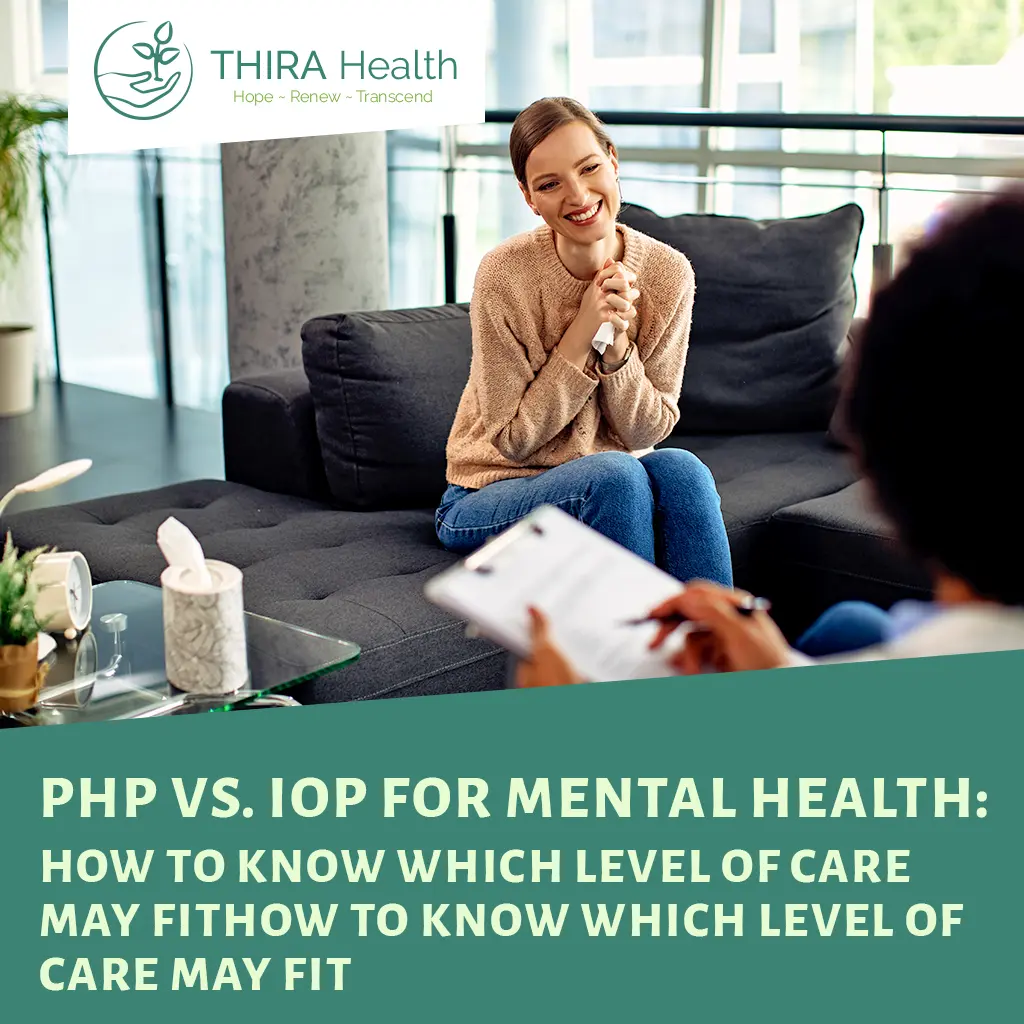
This guide explains the difference between a partial hospitalization program, or PHP, and an intensive outpatient program, or IOP. You will learn how each level of care works, who each supports, and what questions can help you take the next step.
THIRA Health provides DBT-centered mental health treatment near Seattle and Bellevue, Washington, with programming designed to help clients build skills, stability, and support in daily life.
What Is a Partial Hospitalization Program for Mental Health?
A Partial Hospitalization Program, often called PHP, is a structured mental health treatment program that provides support during the day while allowing clients to return home or to a supportive living environment outside of program hours.
PHP is often a fit for someone who needs more than weekly therapy or a few hours of weekly outpatient support. It offers a higher level of structure while still allowing the client to remain connected to home, family, and daily life outside of treatment.
Despite the name, PHP is not the same as inpatient hospitalization. In a mental health PHP, clients typically participate in treatment during scheduled daytime hours and do not stay overnight in a hospital.
PHP may include group therapy, individual therapy, skills practice, clinical support, and whole-person therapies that help clients apply what they are learning in real life.
At THIRA Health, PHP is part of a connected continuum of care that may also include residential treatment and intensive outpatient programming depending on each client’s clinical needs.
What Is an Intensive Outpatient Program for Mental Health?
An Intensive Outpatient Program, or IOP, is a structured level of mental health care that provides more support than traditional weekly therapy while allowing clients to maintain more of their regular daily routine.
IOP usually involves treatment several days per week. It can be helpful for people who need consistent therapeutic support, skills practice, and accountability but do not need the full-day structure of PHP.
For some clients, IOP is the first level of care they enter after assessment. For others, it may be a step-down after PHP or residential treatment.
IOP can be especially helpful when someone is ready to practice coping skills in everyday life while still having regular support from clinicians and peers.
At THIRA Health, IOP includes DBT skills-based programming, group therapy, individual support, and a focus on practical skill-building.
How DBT Fits Into PHP and IOP
Dialectical Behavior Therapy, or DBT, is a skills-based therapy that helps people better understand and manage emotions, tolerate distress, communicate effectively, and stay present during difficult moments.
DBT can be especially helpful for people who experience intense emotions, relationship stress, self-destructive patterns, anxiety, depression, trauma-related symptoms, or difficulty feeling steady in daily life.
In PHP and IOP, DBT can be practiced repeatedly. This matters because emotional regulation skills are not usually learned from one conversation or one worksheet. They often need to be practiced in community, discussed with clinicians, and used again and again in real-life situations.
DBT skills may help clients work on:
- Mindfulness
- Distress tolerance
- Emotion regulation
- Interpersonal effectiveness
- Building more stable daily routines
- Communicating needs more clearly
- Responding to stress without making things worse
At THIRA Health, DBT-centered programming is a core part of care across multiple levels of treatment. This allows clients to learn skills, practice them, and continue building on them as their needs change.
Conditions PHP and IOP May Support
PHP and IOP may support people experiencing a wide range of mental health concerns, depending on clinical fit and program structure.
These may include:
- Depression
- Anxiety
- Bipolar disorder and other mood-related concerns
- Trauma and PTSD-related symptoms
- Borderline personality disorder and emotion dysregulation
- Self-harm behaviors or suicidal ideation that do not require acute inpatient care
- Difficulty functioning in school, work, or relationships
- Challenges with distress tolerance and emotional overwhelm
Every person’s situation is different. A diagnosis alone does not determine the right level of care. The full picture matters, including symptoms, safety, functioning, treatment history, family support, and goals.
PHP and IOP at THIRA Health
THIRA Health provides DBT-centered mental health treatment near Seattle and Bellevue, Washington.
Care is designed for people who need more support than weekly therapy and may benefit from structured treatment, skills practice, individual support, group connection, and whole-person care.
Depending on clinical fit, THIRA may support clients through residential treatment, partial hospitalization programming, intensive outpatient programming, or a step-down pathway across levels of care.
THIRA’s approach emphasizes practical DBT skills, emotional regulation, community support, and compassionate care that helps clients build a life that feels more stable and connected.
Final Thoughts
Choosing between PHP and IOP can feel overwhelming, especially when someone you love is struggling or when weekly therapy no longer feels like enough.
You do not have to make that decision alone.
PHP and IOP both offer structured support, but they serve different needs. PHP may be a fit when someone needs more intensive daytime care. IOP may be a fit when someone needs structured support while maintaining more of their regular routine.
The right next step is a compassionate assessment that looks at the full picture.
THIRA Health can help individuals and families understand which level of care may fit and what support options are available near Seattle and Bellevue, Washington.
To learn more about PHP, IOP, and next steps for care, contact THIRA Health at (425) 454-1199 or connect with THIRA Health online.