

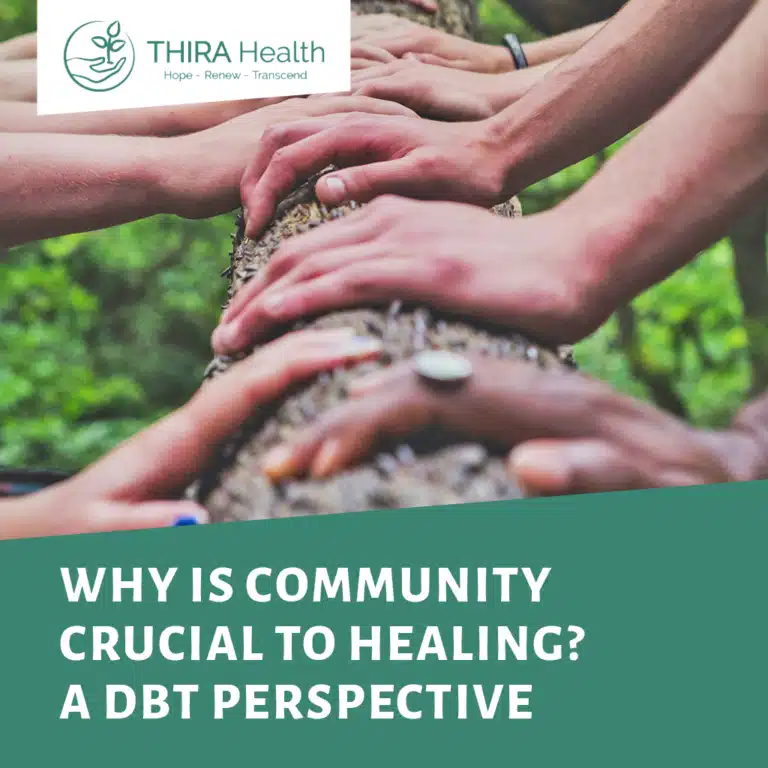
Why do we need interpersonal connections as part of the healing process?
Our mental well-being hinges on many factors, and one of the most crucial is our sense of connectedness to others. This isn’t to say that you need a certain type of social connection, like a marriage or a close relationship with your parents, to thrive. What’s most important is having connections that help you feel accepted, cared about, and valued. This can come from coworkers, friends, neighbors, family, a partner, therapists, and more.
Connections give you something to rely on in hard times, a chance to have fun, something to look forward to, and a feeling of purpose and fulfillment. When you’re struggling with mental health, strengthening and even expanding your social connections can help you heal, but those same mental health struggles can make it particularly difficult to see how to strengthen your social connections!
How does a DBT treatment program create community for participants?
Dialectical behavior therapy (DBT) treatment programs take a structured approach to finding community and improving your mental health, helping you build your relational skills so you can improve your relationship to yourself and others. DBT also offers you a chance to create connections in an environment that prioritizes healing, incorporating both program participants and your loved ones in your healing process.
Connection to a therapist can provide relational healing
The one-on-one connection with your individual therapist in a DBT treatment program is instrumental to healing. Your individual therapist can help you understand your mental health conditions and validate your experiences, allowing you to recognize what’s happening when you’re experiencing symptoms of BPD, depression, anxiety, or eating disorders.
From there, you and your therapist will figure out your therapy goals, and you’ll start to learn DBT skills from them. Your therapist will be a collaborator in your healing, there to empower you with knowledge, to hear you when you share both difficult experiences and successes, and to help you problem-solve through what life throws your way. They’ll also be available via phone between sessions, helping you to use your DBT skills when life gets particularly intense.
Your therapist will be a consistent source of both support and accountability. They will have unconditional, positive regard for you, and their steady belief that you can change your life can really help you to make those changes. Your therapist can help you learn to trust and to be vulnerable, and you can learn about your needs and values in a space where you’re emotionally and physically safe. This can be a powerful place to heal from difficult relationships; your therapist can show you that there are safe people and safe connections, helping you develop the skills and discernment to pursue more safe connections and let go of those that aren’t for you anymore.
DBT group therapy creates a community for participants
In DBT skills groups, you will practice your DBT skills with other group participants, focusing on mindfulness, interpersonal effectiveness, emotional regulation, and distress tolerance. You will meet people from different backgrounds, but you’re all in the program for the same reason: you want to change how you respond to your emotions and the world around you, to build a life worth living.
You’ll all know, in different ways, how it feels to have overwhelming, urgent emotions, and you’ll understand what it’s like to have developed unhelpful behaviors to try to cope. You’ll all have had painful moments of self-abandonment or reactions that ruptured relationships. And you’re all there to change your lives, to create a life worth living. You’re there to help and be helped, giving you purpose and support all in one. You’re practicing skills together that improve your relationship to yourself, your emotions, and to each other, creating positive, helpful bonds that have solid, supportive foundations.
DBT therapists understand that belonging, validation, and acceptance matter, and DBT skills groups are a great place to find that acceptance. You’ll know you belong, you all have shared experiences, and you’re here to help each other. You get each other in a way that might be hard to find outside of DBT group therapy, and you can get a lot out of these connections while you’re in the program, and sustain them after you complete it as well.
Family involvement in DBT helps create solid bonds
A home environment where you feel understood and where you can be held accountable in a supportive, helpful way is important to anyone pursuing mental well-being. A lot of family members don’t quite get it when it comes to mental health; they may have misconceptions or be in denial, and while they may want to be supportive, they may not know how.
THIRA Health’s DBT treatment programs include individualized family engagement sessions, where your loved ones can learn more about what you’re going through, helping them understand that what you’re experiencing is real and difficult. They can learn the DBT skills you are learning, so you can all use them together at home.
Creating a family culture that provides support instead of challenges can make a huge difference in sustaining improvements you’ve made with your mental health. The understanding and validation that comes with family support can also be healing in its own right; the people you’re around the most who care about you can and will make changes so you can all better connect, all in the name of supporting your mental health!
DBT skills help you create more rewarding, meaningful connections
DBT is focused on helping you create a life worth living—and social connections are so important to a life worth living. Interpersonal effectiveness is one of the four main pillars of DBT.
Interpersonal effectiveness skills help you create and maintain healthy relationships. Skills like GIVE and FAST help you interact with people in ways that maintain your self-respect and boundaries, while also showing the other person respect, even when you’re struggling with difficult thoughts and feelings. The DEAR MAN interpersonal effectiveness skill gives you a blueprint for having effective conversations and getting your needs met, even when talking about difficult topics or with difficult people. You can combine all these DBT skills to set and defend firm, supportive boundaries, without letting emotional reactions derail your interactions.
DBT mindfulness and emotional regulation skills also help you stay present and enjoy your connections in the moment, even if you’re grappling with mental health symptoms. DBT skills like the STOP skill can help you cut emotional reactions short and make different choices that can help you bond with people instead of lashing out. Opposite Action can help you put yourself out there when you’re feeling shy, or take a moment to calm down when you’re dealing with some strong feelings, helping you match your actions to your life goals when it comes to making meaningful connections.
DBT adds structure and community to residential, partial hospitalization, and intensive outpatient programs
Connection and acceptance are foundational to mental healthcare at THIRA Health. DBT programs that prioritize building community, like those at THIRA Health, recognize that connections to trusted therapists and fellow program participants, alongside family involvement in treatment, improve treatment outcomes and help participants feel that life is indeed worth living.
If you’re ready to get started, contact our team today.